Most customers decide whether to trust your business before they ever call or walk in — they look you up online first. If they can't find you, or what they find looks abandoned, you lose the sale to a competitor who showed up. A web presence isn't about having a flashy site; it's about being easy to find, easy to trust, and easy to contact. This guide walks through what actually matters for a small business, in the order that gets you results fastest.
The short version: claim your free listings so you show up in search and maps, put up a simple website that answers the obvious questions, and keep both accurate. You don't need a big budget or a developer on staff — you need the basics done well.
What "web presence" really means
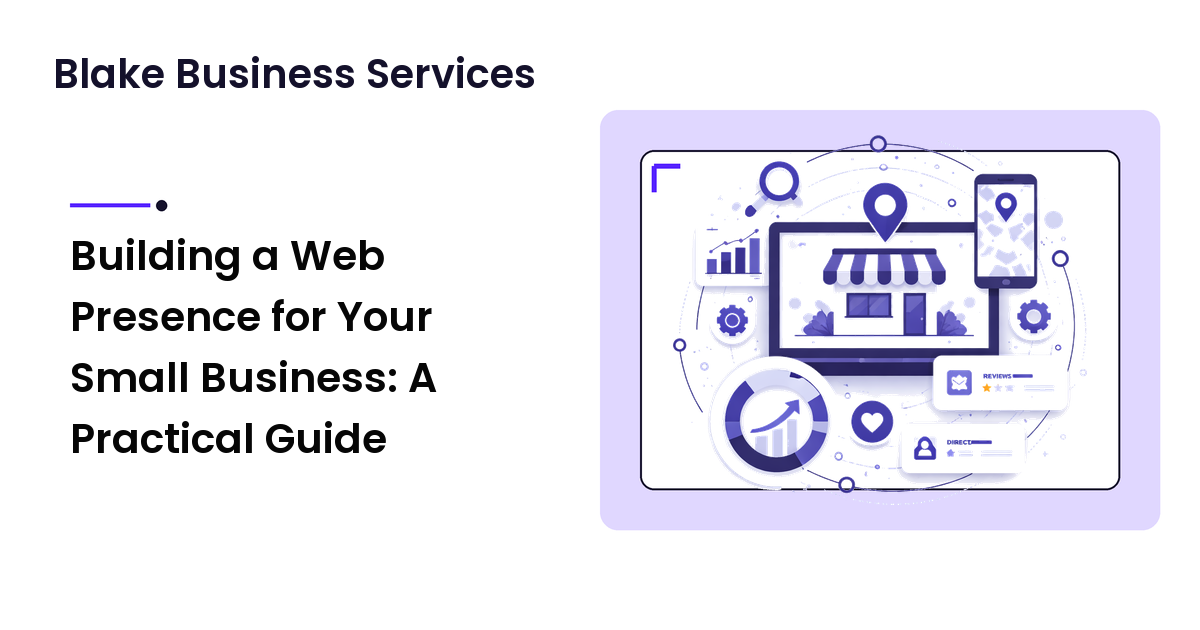
Your web presence is everything someone finds when they look you up: your website, your Google Business Profile, map listings, social profiles, and reviews. Customers rarely visit just one of these. They might find you on a map, glance at your reviews, then click through to your site to check your hours and prices. Each piece reinforces the others — or undermines them if one is out of date.
The goal is simple: when a potential customer searches for what you offer in your area, you appear, you look credible, and they can act. Everything below serves that goal.
Step 1: Claim your free listings first
Before you spend a cent on a website, claim the listings that put you on the map — literally.
- Google Business Profile is the single highest-impact thing for most local businesses. It's free, it puts you in Google Maps and the local results, and it shows your hours, photos, and reviews. Claim and fully complete it.
- Apple Maps (Apple Business Connect) matters for the large share of customers on iPhones.
- Industry and directory listings — think Yelp, Bing Places, and any directory specific to your trade.
The reason to start here is leverage: these listings are free, they rank well, and they often drive calls and visits before a website ever does. Keep your name, address, and phone number identical everywhere — inconsistent details confuse both customers and search engines.
Step 2: Put up a simple, honest website
You don't need ten pages or custom design to start. A clear one- to five-page site beats an ambitious site that never launches.
The pages that earn their keep
- Home — who you are, what you do, where you serve, and how to contact you, all visible without scrolling far.
- Services or products — what you offer and, ideally, a sense of price or starting price.
- About — a few honest sentences and a real photo build more trust than stock imagery.
- Contact — phone, email, a simple form, your area served, and a map.
How to build it without overpaying
You have three realistic paths, each with a trade-off:
- A website builder (Wix, Squarespace, or similar) — fastest and cheapest to launch yourself; best when you want control and a small budget.
- WordPress — more flexible and portable; best when you expect to grow the site or want to avoid being locked into one platform.
- Hiring a designer or agency — best when your time is more valuable than the cost, or when you need something custom; ask for a site you can edit yourself afterward.
Whichever you choose, make sure the site loads fast, works on phones, and lists your contact details on every page. Most visitors are on mobile, and a slow or broken mobile site quietly costs you customers.
Step 3: Be findable in search
Getting found is mostly about clarity and consistency, not tricks.
- Say what you do and where, in plain words. "Plumber in Springfield" should appear naturally in your page titles and headings, because that's what people search.
- Keep your listings consistent with your website (Step 1 pays off here).
- Gather reviews honestly. Ask satisfied customers to leave a review; reviews influence both rankings and the decision to call.
- Add a few useful pages over time — answers to common customer questions are exactly what search engines like to show.
This is the foundation of local SEO. It compounds: a complete profile plus a clear site plus steady reviews will outperform expensive shortcuts.
Step 4: Keep it accurate and alive
An out-of-date web presence is worse than none — wrong hours or a dead phone number erodes trust instantly.
- Update hours around holidays and changes.
- Add a few fresh photos now and then.
- Respond to reviews, especially the critical ones, calmly and helpfully.
- Check once a quarter that every listing still points to the right info.
A small, consistent habit keeps everything trustworthy with very little effort.
A simple starting plan
- Claim and complete your Google Business Profile and other free listings.
- Launch a simple site with home, services, about, and contact pages.
- Make yourself findable with clear wording, consistent details, and real reviews.
- Maintain it with a quick quarterly check.
FAQ
Do I really need a website if I have a Google Business Profile?
A complete Business Profile alone can carry a very small or local business at first. But a simple website gives you a place customers fully control your message, list all your services, and look more established — and it strengthens your search visibility. Start with the profile, add the site soon after.
How much should a small business website cost?
It ranges widely. A self-built site on a website builder can cost only a monthly subscription, while a custom site from an agency can run into the thousands. Choose based on your time and needs: builders are cheapest and fastest, a designer costs more but saves you the work.
What's the fastest way to show up on Google?
Claim and fully complete your Google Business Profile, keep your business details consistent everywhere, and earn genuine customer reviews. For local searches, this typically moves the needle faster than anything else.
How often should I update my web presence?
Update hours and details whenever they change, and do a quick review of all your listings and pages once a quarter. Responding to new reviews promptly also keeps your presence active and trustworthy.
Next step
Pick the two highest-leverage moves and do them this month: claim your free business listings and get a simple, honest one-page site live. Once those are solid, layer on reviews and a few helpful pages over time. A modest web presence done well beats an elaborate one you never finish.