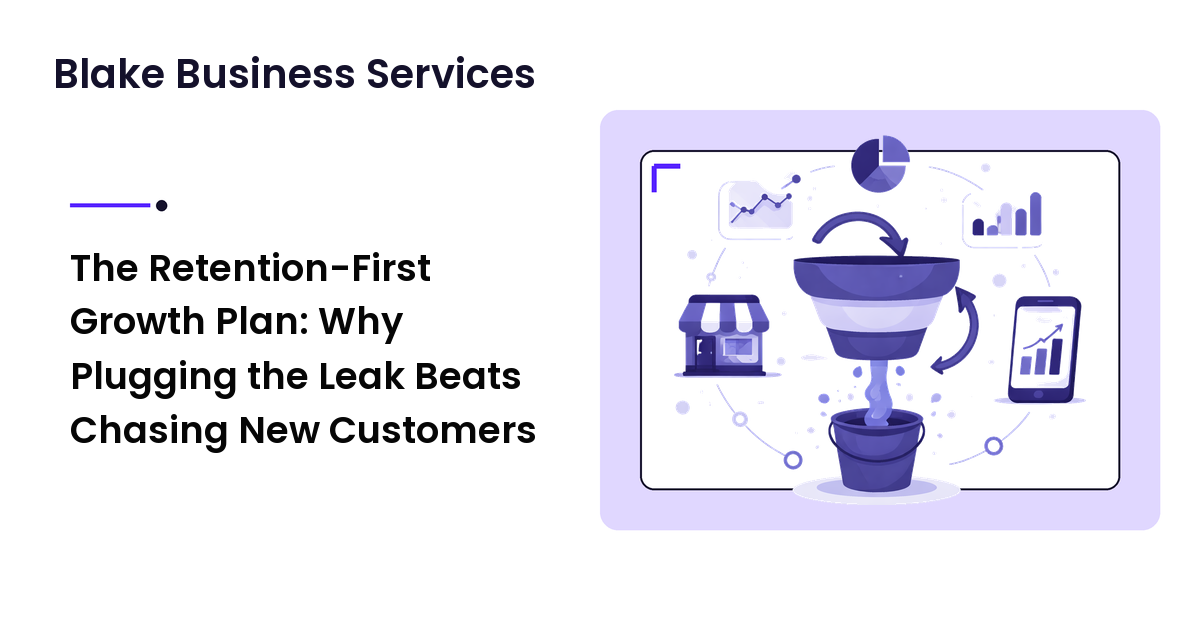
Most small business growth advice points one direction: get more customers. More ads, more leads, more reach. But for the typical small business, the faster and cheaper win is hiding on the other side of the ledger — the customers you already won and are quietly losing. Here's the takeaway: growth is a bucket, not a funnel. If the bucket leaks, pouring in more water is the most expensive way to fill it.
This guide gives you a retention-first growth plan: how to measure your actual leak, why fixing it usually beats chasing new business, a worked example with real numbers, and the mistakes that keep owners stuck on the acquisition treadmill. None of it requires a big budget — most of it requires a spreadsheet and a few honest hours.
The hard problem: acquisition is loud, retention is silent
New customers are visible. You see the ad spend, the leads, the first sale. Lost customers are invisible — they simply don't come back, and nobody sends a notification when a regular drifts away. So owners optimize what they can see and ignore what they can't, even though the silent side often costs more.
The math is unforgiving. Winning a new customer typically costs several times more than keeping an existing one, because acquisition means ads, time, discounts, and trust you have to build from zero. A returning customer already trusts you, already knows where you are, and usually spends more per visit. Yet most small businesses have no idea what fraction of customers come back — which means they're flying blind on their single biggest lever.
Step 1: Measure your real leak
You can't fix what you don't measure. You need two numbers, and you can pull both from whatever record you already keep (a POS, a booking tool, an invoice list, even a notebook).
- Repeat rate. Of customers who bought in a given period, what share bought again within a sensible window for your business (90 days for a café, a year for an accountant)? That's your retention floor.
- Revenue concentration. What share of your revenue comes from repeat customers versus first-timers? Often a small loyal core carries most of the business.
Do this even roughly. If your repeat rate is, say, 20%, four out of five customers are one-and-done — and that is your growth problem, not a lack of leads. If it's 60%, your engine works and pouring in new customers will compound. The number tells you where to spend.
Step 2: Find where customers leak out
Retention rarely fails for mysterious reasons. Map the customer's journey from first purchase to second and look for the drop-off:
- No reason to return. The product was fine, but nothing reminded them or made coming back easy. The most common leak, and the cheapest to fix.
- A bad post-sale experience. A clumsy follow-up, an ignored question, a hard-to-reach business. Trust evaporates quietly.
- No way to reach them again. You never captured an email, phone number, or any permission to follow up — so a happy customer simply forgets you exist.
That third leak is the one to close first, because it's free and it unlocks every other fix. If you can't contact past customers, you can't bring them back no matter how good your product is.
Step 3: Fix the leak before you scale acquisition
Retention fixes are usually small, cheap, and dull — which is why they're skipped:
- Capture contact details at the point of sale with permission, then actually use them: a short, useful follow-up, a reason to return, a genuine thank-you.
- Build one repeat trigger suited to your business — a reminder when a service is due, a loyalty perk, a check-in after a big purchase.
- Remove one source of friction in the post-sale experience: answer faster, simplify rebooking, fix the thing customers complain about most.
Once your repeat rate is climbing, then turn up acquisition — and make it compound by feeding new customers into a system that keeps them. New-customer marketing and retention are partners, not rivals; for the acquisition half, our digital marketing guide covers the channels that fit a small budget.
A worked example
Say you serve 100 new customers a month, average order $50, and your repeat rate is 20%. Roughly 20 come back; over a year that base churns constantly and you're forever replacing it with paid leads at, say, $15 each — about $1,500 a month just to stand still.
Now suppose a $0 fix — capturing emails and sending one well-timed follow-up — lifts repeat rate from 20% to 35%. That's 15 extra returning customers a month at $50, or $750 in monthly revenue you weren't getting, with no added ad spend. Better still, those returners often spend more and refer others, so the gain compounds while your acquisition cost per real customer quietly drops. The same 15 customers bought through ads would have cost you money; bought through retention, they cost almost nothing.
That's the whole argument in numbers: a modest retention gain frequently beats a large acquisition push, at a fraction of the cost.
Common mistakes and why they happen
- Treating growth as purely a traffic problem. More leads into a leaky bucket just raises your costs. Owners do this because traffic is measurable and motivating, while churn is abstract.
- Discounting to win new customers while ignoring loyal ones. New-customer-only deals can insult the regulars carrying your revenue. Reward loyalty at least as well as you court strangers.
- Never capturing permission to follow up. The most expensive omission in small business. Without a contact list, every customer is a one-night stand.
- Skipping measurement. "We get plenty of repeat business" is a feeling, not a number. Feelings overestimate retention almost every time.
The one move to remember
Calculate your repeat rate, then decide where to spend. If it's low, your cheapest growth is plugging the leak; if it's healthy, acquisition will compound. One honest number reframes the entire plan — and most owners have never run it.
FAQ
Isn't getting new customers the only real way to grow?
No. Growth is new customers times how long they stay and how much they spend over time. Improving the second half often costs far less than the first, and it makes every new customer worth more — so retention and acquisition multiply each other.
How do I measure retention if I don't track much data?
Start rough. Look back over your records and estimate what share of customers bought more than once in a reasonable window. Even a ballpark figure tells you whether your bucket holds water before you pour more in.
What if I genuinely have very few customers yet?
Early on, acquisition matters more — you need a base to retain. But build the retention habits (capturing contacts, following up) from day one, so growth compounds instead of leaking as soon as it arrives.
How much should I spend on retention versus acquisition?
There's no fixed ratio, but if your repeat rate is low, the cheapest gains are almost always in retention first. Fix the leak, watch the repeat rate rise, then scale acquisition into a system that keeps the customers it wins.
Next step
This week, pull your records and calculate two numbers: what share of customers come back, and what share of revenue they drive. That single hour usually reveals whether your real growth problem is too few leads or too many leaks — and it tells you exactly where the next dollar should go.